Summary
DaVinciBot, the student robotics association of ESILV (Paris & Nantes, France), designed and prototyped OPEN-WEIGHT: an open-source high-precision weight sensor board based on the AD7190 24-bit sigma-delta ADC. This post walks through our goals, design choices, and prototyping journey, and how Aisler helped us iterate faster.
Introduction
DaVinciBot is the student robotics association of ESILV - École Supérieure d’Ingénieurs Léonard de Vinci, with teams in Paris and Nantes. We are primarily known for our participation in the Coupe de France de Robotique (French branch of Eurobot), where we compete each year with fully autonomous robots.
Beyond competition, we invest time in internal R&D projects that build skills and tools for the long term. OPEN-WEIGHT is one of those: a side project initiated by Dimitry SIEBERT, born from a desire to better understand precision analog measurement, signal conditioning, and low-noise PCB design, all skills that feed directly back into our competition robots.
The Project
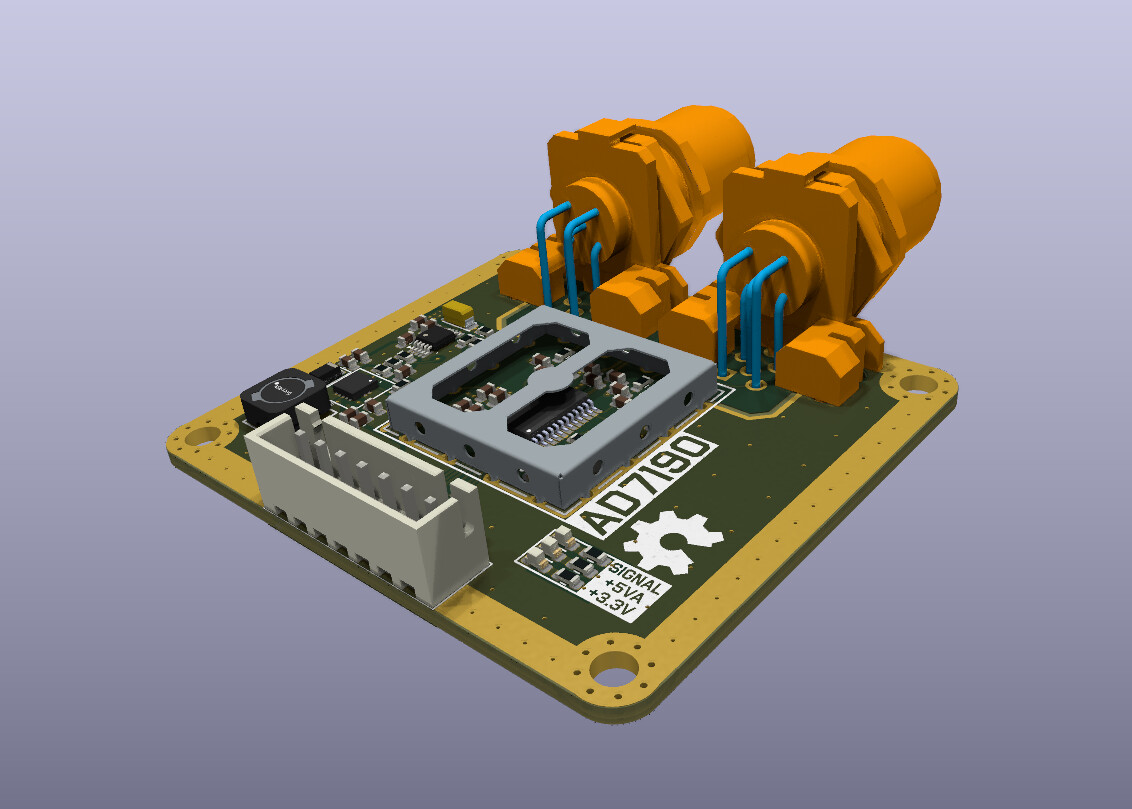
OPEN-WEIGHT is a compact open-source board designed to interface with standard load cells and output precision weight measurements over SPI.
At its core sits the AD7190 from Analog Devices: a 24-bit ultra-low-noise sigma-delta ADC with 28 nV p-p input noise and a programmable gain amplifier (PGA) ranging from 1x to 128x. This combination makes it possible to resolve sub-gram variations from a standard Wheatstone bridge load cell, with configurable output data rates from 4.7 Hz up to 4.8 kHz depending on the accuracy vs. speed trade-off required.
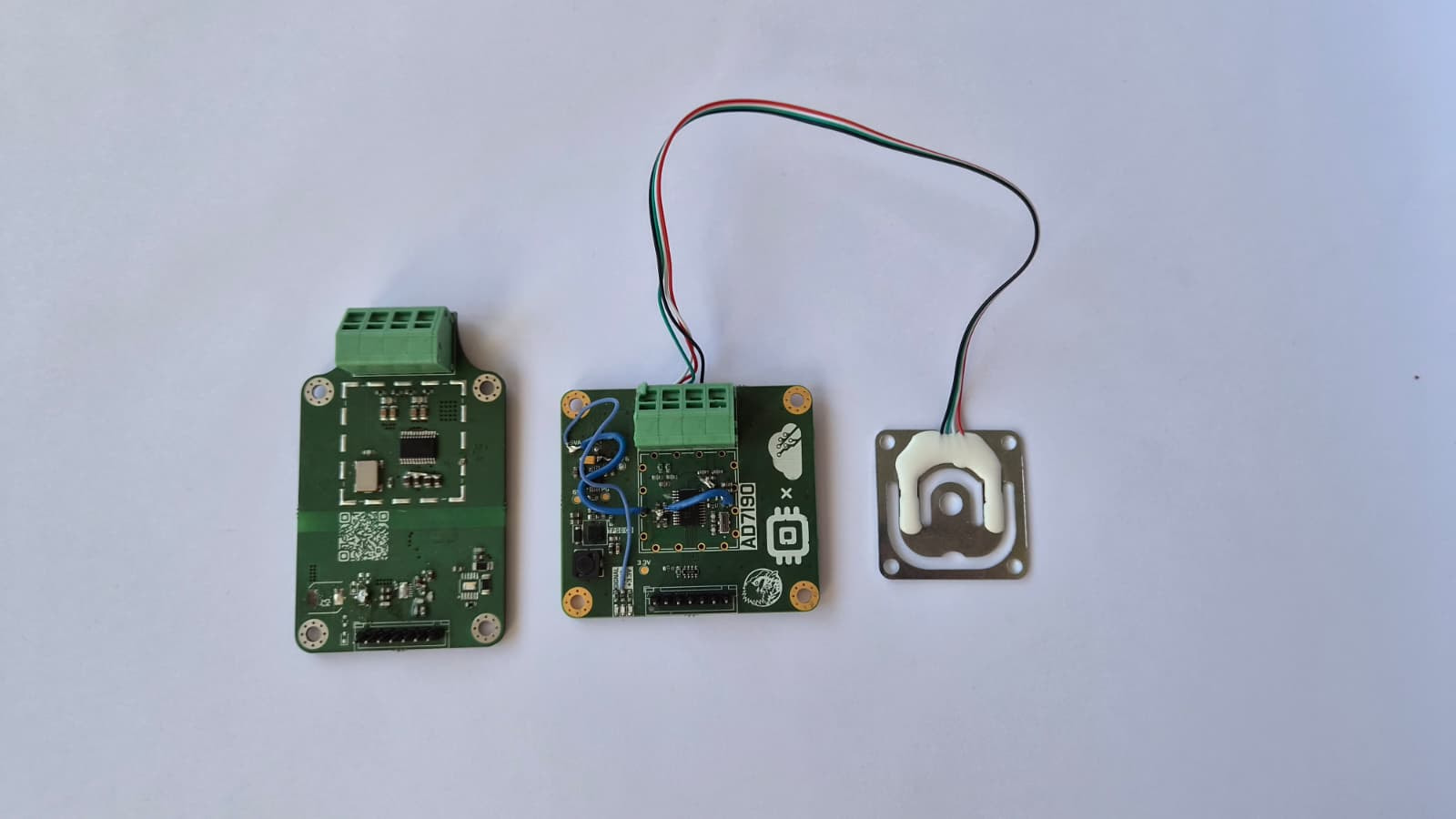
The board connects directly to a load cell via a 4-wire configuration (IN+, IN-, OUT+, OUT-) and exposes an SPI interface for readout. A secondary board handles power conditioning and host-side interfacing.
The Electronics
Key design decisions included:
- Running the AD7190’s internal PGA at a gain of 128 to amplify the weak millivolt-level differential signal from the load cell bridge
- Adding a dedicated low-noise power supply stage to keep interference off the analog measurement chain
- Designing the footprint to accommodate both panel-mount load cells and flat strain gauge formats
The board went through two main prototyping iterations:
- First prototype (non-functional): Identified layout issues in the analog input routing and a footprint mismatch on the AD7190 socket. Classic first-spin problems, but very instructive ones.
- Second prototype (functional): Corrected layout, improved ground planes, and successfully validated SPI communication and stable weight readings. Sub-gram resolution confirmed.
This kind of iteration is exactly where Aisler’s manufacturing speed made a real difference: we could identify issues on the first board, update the design, and have a corrected board back in hand quickly enough to stay within the same development sprint.
Open Source
OPEN-WEIGHT is fully open source. Design files and documentation will be published shortly. We hope it can be useful to other student teams working with load cells or exploring precision ADC design.
A big thanks to Aisler for their continued support of DaVinciBot, fast and reliable European PCB manufacturing that keeps our iteration cycles moving. 
 As soon as it’s public, feel free to add a link here. Looking forward
