Päyload 2.0 is a satellite payload developed by SeeSat e.V. for the Stuttgart Operated University Research CubeSat for Evaluation and Education 2 (SOURCE-2) satellite, operated by the Institut für Raumfahrtsysteme (IRS) at the university Stuttgart. As part of this payload a collection of memory ICs will be tested for radiation hardness, to judge the viability of using commerical-off-the-shelf (COTS) memory instead of expensive radiation hardened products.
Experiment Setup
The experiment is divided into two groups, namely a RAM experiment and a ROM experiment.
To judge the performance of the memory ICs, the measured radiation dose will be measured by another experiment onboard Päyload 2.0. This ambient measurement unit (AMU) is responsible for detecting different types of radiation present in the targeted low earth orbit (LEO). While not much radiation is expected in this orbit, a certain spot over the south atlantic ocean, the so-called south atlantic anomaly (SAA), has strongly increased rates of ionizing radiation, as it forms an extension of earth’s Van Allen radiation belt. Even though the final orbit is not yet decided, flying close to said anomaly could allow for significantly improved measurement quality.
RAM Experiment
The RAM experiment’s goal is to judge the differences between SRAM and DRAM components, whilst also validating a previously implemented Software based Error Correction Code (SoftECC) algorithm. For this purpose three chips will be compared:
-
SRAM with Hard-ECC: 23AA04M-I/SN
-
SRAM: IS62WVS5128GALL-30NLI
-
DRAM: IS66WVR4M8ALL-104NLI
The choice of SRAM and DRAM was made, because both are readily available, yet very different in their expected susceptibility to radiation. DRAM cells consist of a capacitor, storing the relevant information as a tiny charge, which needs to be refreshed periodically to compensate for leakage currents and ionizing radiation may very easily disturb this charged capacitor, leading to a flipped bit or single event upset (SEU). SRAM is traditionally built using two inverters keeping each other stable at the current latched state. Therefore, SRAM cells are typically more resilient to DRAM, as slight voltage changes inside the cell are quickly brought back to supply voltage levels through the inverters.
Additionally, one of the ICs is equipped with a hardware error correction code (HardECC) algorithm, to provide even more resilience to SEUs. The other ICs will be equipped with a SoftECC algorithm that was previously implemented by other students at SeeSat. Through these means an informed decision on the type of memory to be used in SeeSat’s main mission, ERWIN, is supported.
ROM Experiment
The ROM experiment’s goal is to gather data on the data retention of MRAM components and their usefulness as memory for the satellite’s firmeware’s golden image.
-
MRAM 1: AS1016204-0108X0PSAY
-
MRAM 2: EM016LXQBB313ES2T
-
FLASH: IS25WP016D-JBLE
The big difference between FLASH memory cells and MRAM memory cells is the way in which the individual bits are stored. While FLASH uses electric charge carriers trapped in floating gates, MRAM saves data in the magnetic charge of a magnetoresistive material, which is a lot less susceptible to radiation events.
PCB Design
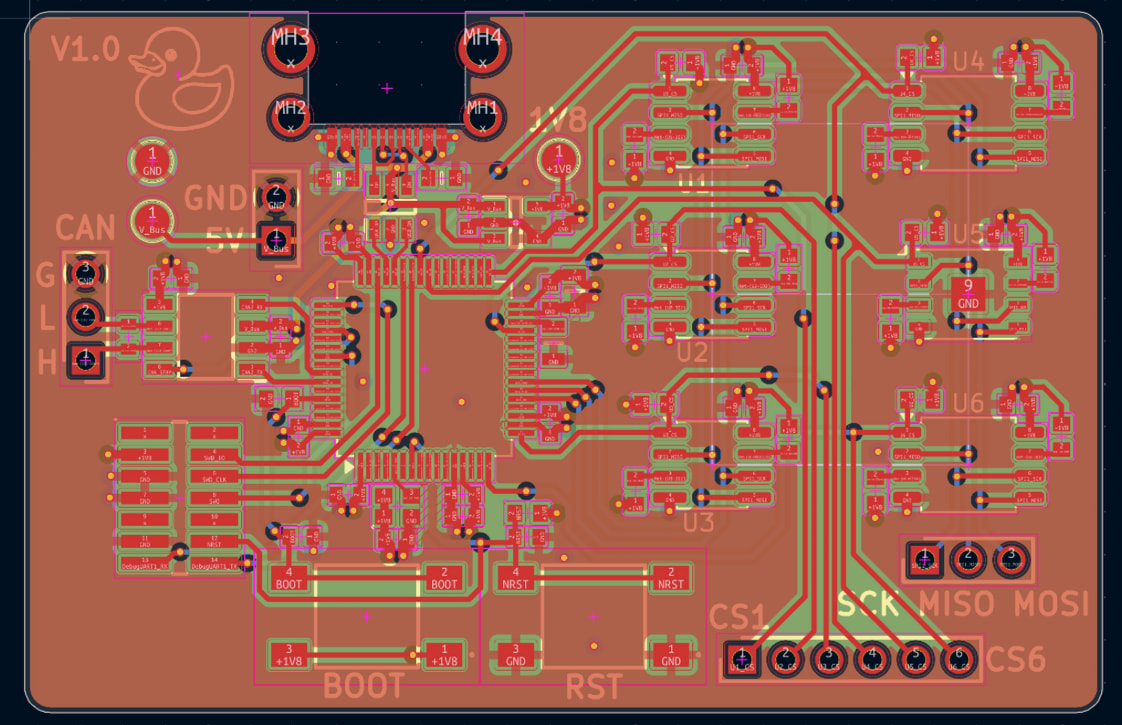
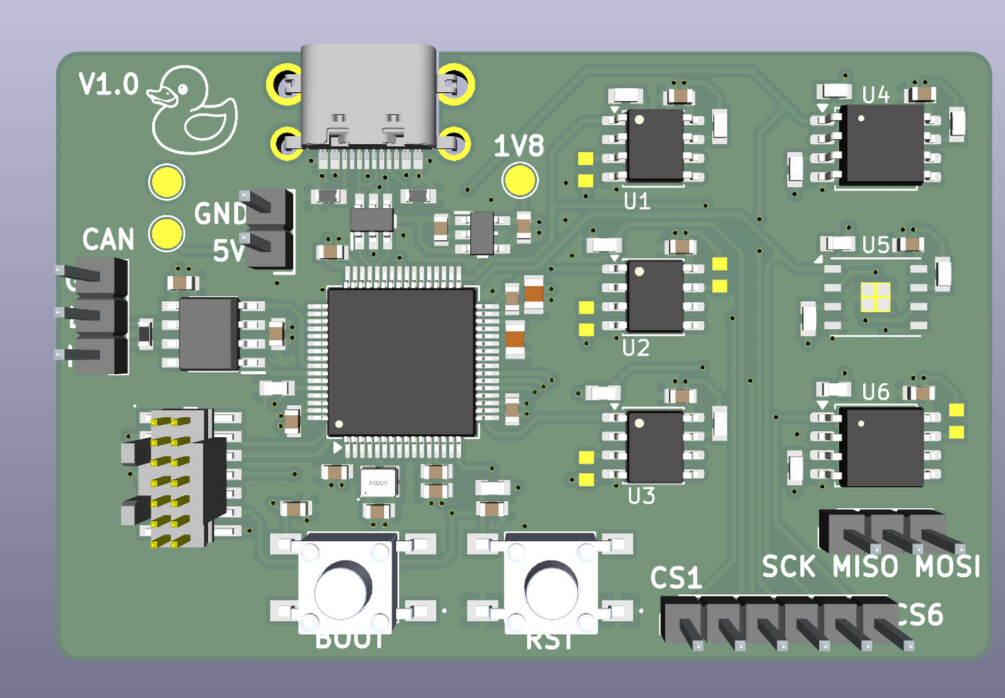
To develop the software for these experiments a devboard with all of the ICs and a microcontroller to control them all is required. While the target controller is a AMD/Xilinx MP-SoC, the hardware drivers will be developed using the more accessible STM32 platform. Because Päyload 2.0 uses a CAN-Bus internally, the STM32F421RET6 was chosen, because it has a built-in CAN controller and supports USB device-firmeware-upgrade (DFU).
The memory ICs all work with 1.8V supply voltage and use SPI for communicating with the controller, which makes connecting them to the STM32 trivial. The board is powered using a USB-C socket for ease of use, but provides external headers for a lab-bench power supply.
The 60mm x 40mm 4-layer PCB was designed using KiCAD 10
Expected Results
The experiment aims to provide new data for COTS memory components to reduce the future cost of SeeSat’s and other student groups’ satellite missions, as the effects of radition in low earth orbit are not well document and accessible to the public.