Servus!
We are Strohm und Söhne e.V., the Formula Student Team of the University of Applied Sciences Nuremberg. Our team is designing and manufacturing a fully electric race car every year, competing in events internationally. The ECAD software of choice is Altium Designer with their Altium 365 Cloud service, preparing us for the professional workspace.
The Driverless Challenge
This season, we faced one of the biggest changes in the history of our team: the implementation of our first driverless system for the “NoRa12”. This switch introduced entirely new challenges and necessitated high-power units, such as a 12V driverless PC and our electric steering motor. Integrating these sensitive Driverless (DV) components into the tight packaging of a race car proved pretty difficult.
A New Two-Stage Power Architecture
To manage the new requirements, we had to adapt our Low Voltage System architecture. To manage the power demands of our new high-power units, we completely revisited our DC/DC converter setup. While we have always powered our low-voltage system directly from the tractive system battery, we previously stepped the voltage directly down to 24V. Now, we use an two-stage approach: the tractive system voltage is first divided by 16, providing an intermediate voltage of 25V to 37.5V. Inside our new LVS Box, the Power Distribution Unit (PDU) then precisely regulates this intermediate voltage down to both our traditional 24V and the newly required 12V.
The Modular LVS Box
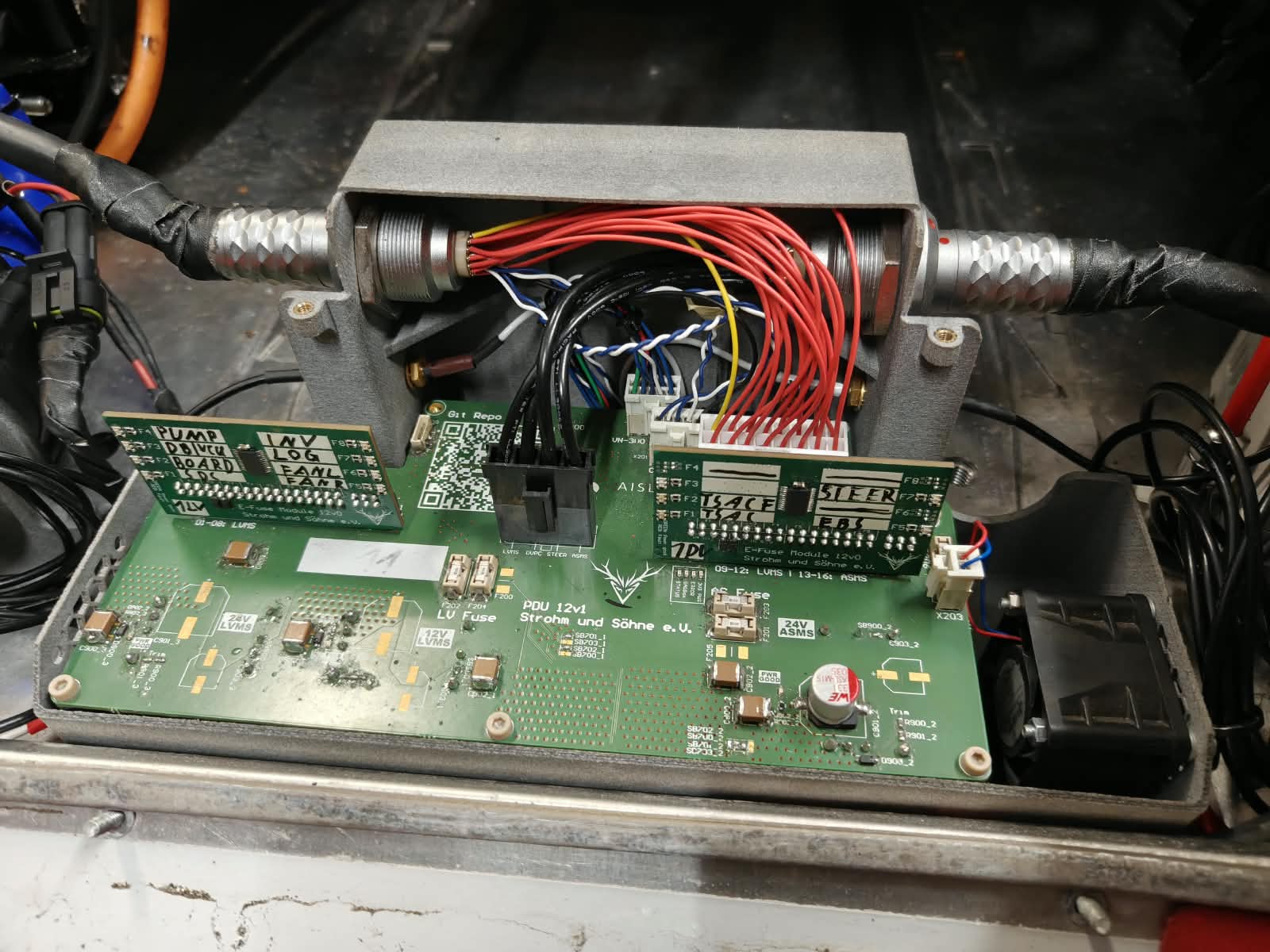
To package everything securely, the LVS Box tightly integrates the PDU and our INS sensor, requiring only a single robust external connector for all power and signals. Inside the box, the PDU acts as a mainboard featuring specialized slots for different functional PCBs. This modular, cable-free internal connection eliminates wiring messes and greatly eases the assembly process. (The rest of the cable clutter will be cleaned up in future iterations.  ) Both of these slots house our newly developed e-fuse card. These electronic fuses allow us to accurately monitor currents and dynamically emulate fuse behaviour via software. Thanks to the mainboard’s slot design, we also have a fool proof fallback: if we ever face software issues or need a hardware-only guarantee, we can simply swap the e-fuse card with a custom drop-in replacement card utilizing traditional melt fuses. This ensures our vehicle’s low-voltage systems remain fully protected and operational at all times.
Thank You, AISLER!
Ordering PCBs and receiving them fast was essential this season to iterate on our new systems. A huge “thank you” to AISLER for your support, and for giving our students the opportunity to let their complex designs become reality. This was our first season with AISLER and we are very happy with them, especially their telephone support was a great help this year.