Hi everyone in the AISLER community!
We are AU Dolphins, the Formula Student team from Aarhus University in Denmark. This summer we’ll be competing in our second Formula Student competition. Last year our car didn’t have any electronics, so this season our goal has been to build a fully drivable electric race car.
Our car relies on CAN bus communication between the Vehicle Control Unit (VCU) and the various slave nodes. During software development, one of our challenges was creating a reliable CAN test bench. We initially relied on off-the-shelf CAN transceivers connected through breadboards, but the loose connections made debugging frustrating.
The solution was to build a custom breakout board. Since our CAN nodes use STM32H563ZI microcontrollers we choose to make the breakout board around the STM32H5 Nucleo-144 board (MB1404). The goal was not only to create a reliable CAN test bench, but also to keep all possibilities open to test future ideas. Using STM32CubeMX we found the best way to distribute the functionality of the STM32H563ZI microcontroller while taking advantage of alternate pin functions to keep as many interfaces available as possible.
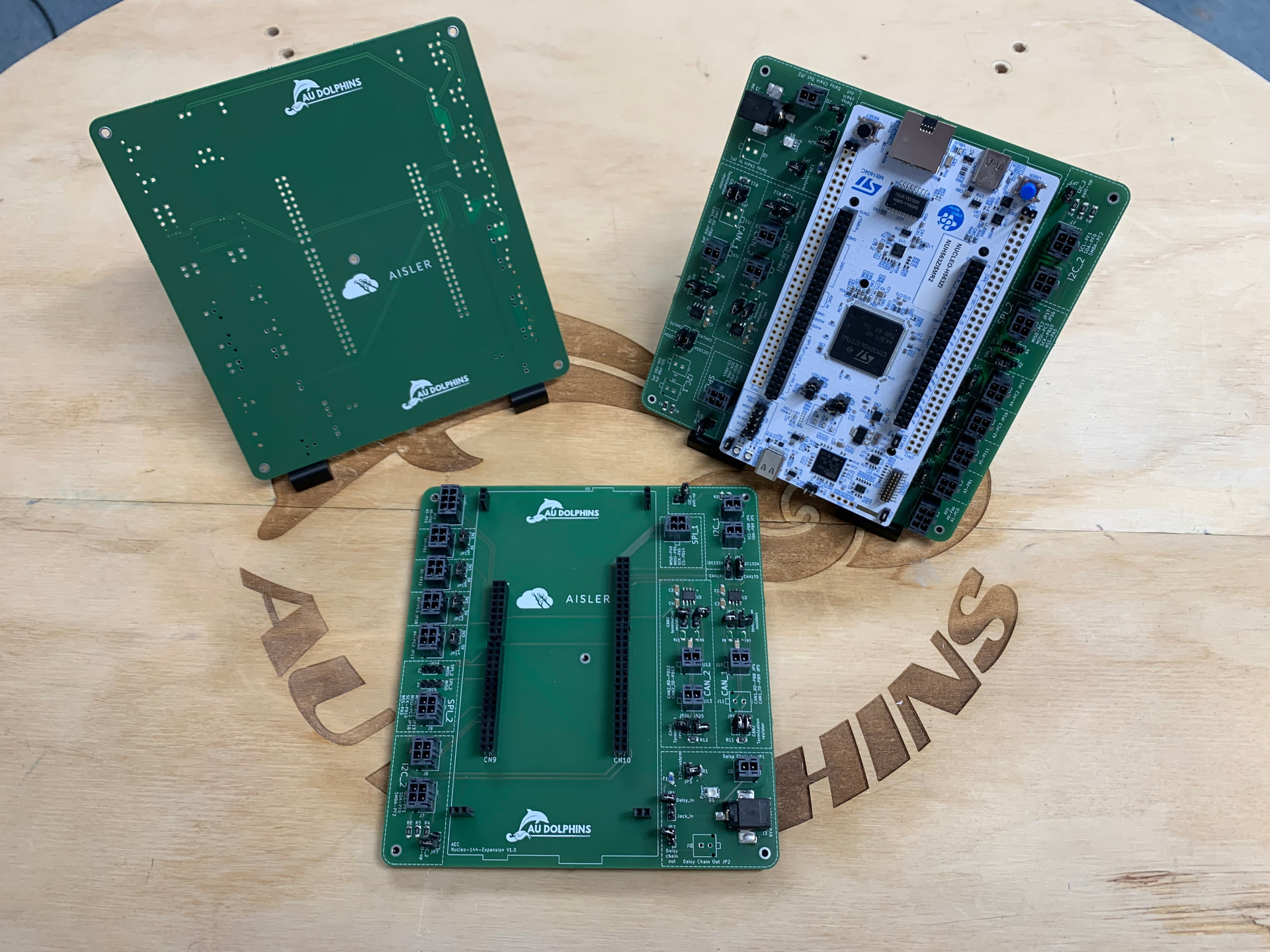
The PCB includes:
-
Power delivery circuit with daisy chain capability
-
Four analog connections
-
A dedicated connector for our accelerator pedal sensor
-
Two independent SPI buses
-
Two independent I2C buses
-
Two independent CAN buses with jumpers to toggle termination resistors
Using two ATA6563-GAQW1 CAN transceivers and the WR-MPC3 connecters from Würth for reliable connection, the result is a robust development platform that lets us focus on writing firmware instead of troubleshooting wiring. Combined with AISLERS excellent PCB manufacturing and quality we can confidently work towards our first fully drivable Formular Student race car.