Hello,
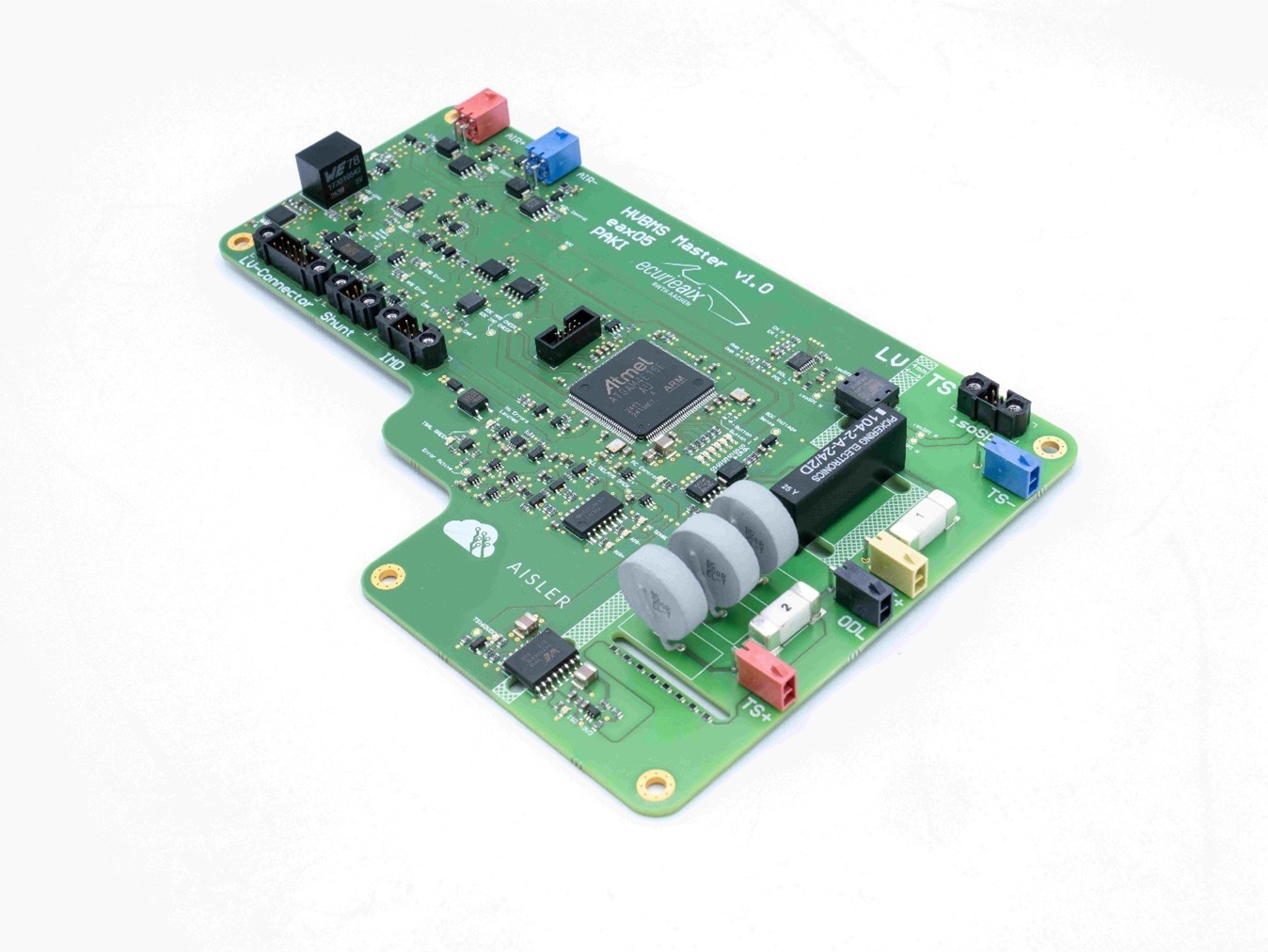
We are Ecurie Aix, the Formula Student team from the RWTH Aachen. We design and manufacture a fully electric race car to compete in Formula Student competitions against teams from other universities from around the world. For our electronics we design and use many different PCBs throughout the entire vehicle which are all kindly supported by AISLER. One such board is our HVBMS which is presented in this article.
The main task of the HVBMS is to monitor the voltage and temperature of each individual cell, as well as the total current of the HV battery, and to safely disconnect it from the vehicle’s traction system in the event of a fault. To do this, the cell voltages and temperatures from each stack are measured using a cellboard and transmitted to the HVBMS via isoSPI. There, the data is processed by the HVBMS microcontroller and can then be read out via the integrated CAN interface.
Since the HVBMS is a system of particular safety relevance, high demands are placed on its reliability, robustness, and functionality. We are all the more proud that we have been driving with our in-house developed HVBMS since 2018 and are continuously refining it.
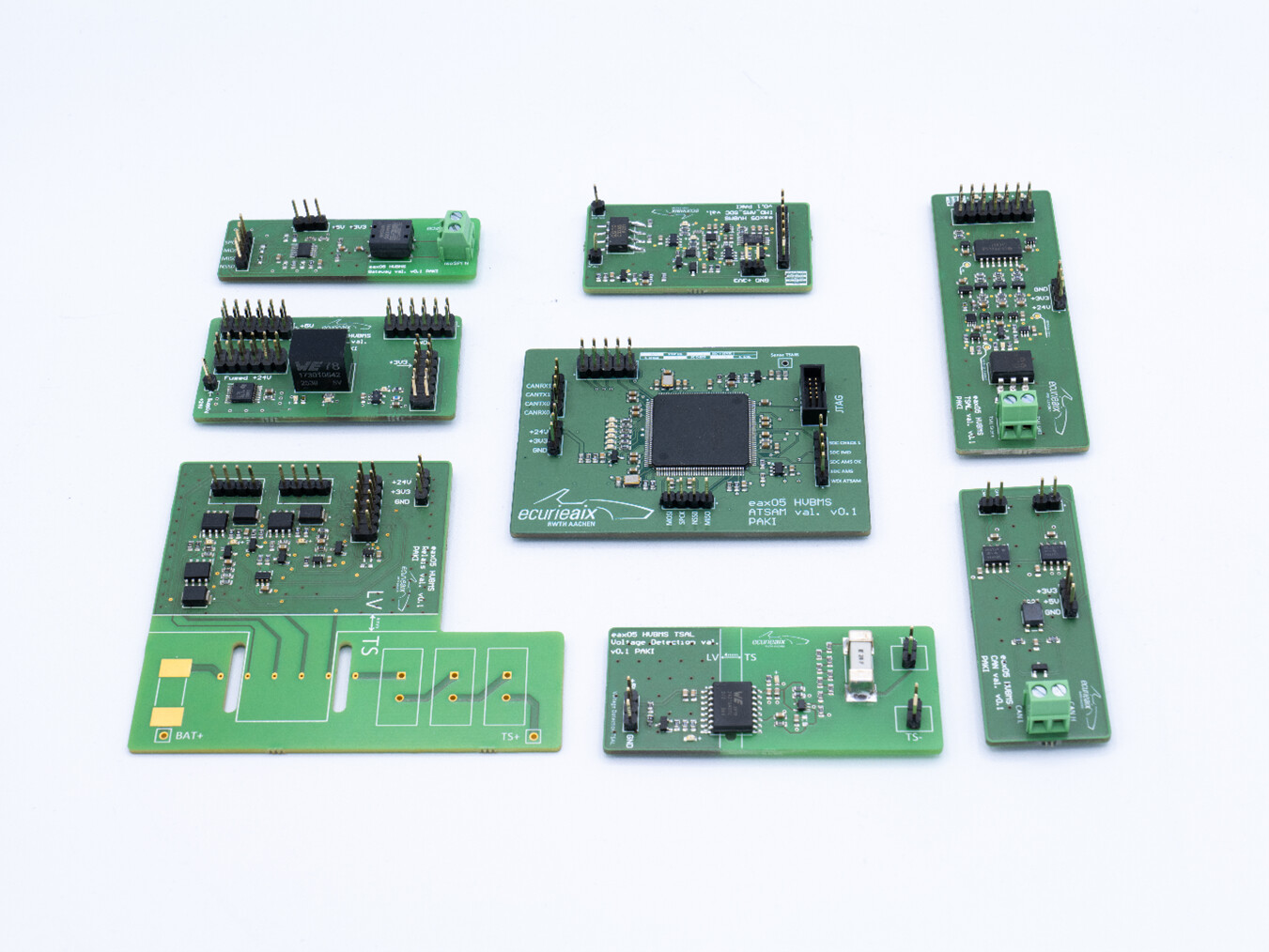
To keep the HVBMS state-of-the-art, we designed a total of 8 development boards this season. These represent the individual functional modules of the HVBMS. This includes the power supply, the microcontroller, as well as the isoSPI and CAN interfaces. Added to this are Formula Student-specific functions such as TSAL logic, high-voltage detection, and the IMD/AMS error latch.
By dividing the system into individual PCBs, we can further develop specific modules and then easily test them within the overall system without having to create a completely new HVBMS layout each time. At the same time, it becomes much easier to validate and debug individual functions separately, making our development process more efficient and flexible.
Reliable, high-quality PCBs are of crucial importance, especially for a system as safety-critical as this one. Aisler’s support helps us implement our development boards quickly, precisely, and to a high standard. This allows us to test new concepts efficiently and continuously improve our HVBMS.