Introduction
We are a student-led rocketry group of around 100 members from the Karlsruhe Institute of Technology (KIT) in Germany. Our ultimate goal is to build a self-landing, bi-liquid hopper rocket. Every component of this hopper is designed and manufactured in-house by our team.
We are divided into specialized sub-teams: the Engine team designs and tests our liquid-propellant rocket engine; the Structure team develops the tanks and the rocket’s airframe; and the Avionics team writes the flight software and designs the flight computers. Recently, Avionics has been focused on developing our new Engine Control Unit (ECU).
The ECU Architecture
The ECU is a modular system consisting of three distinct boards:
- ECU_SENS: Hosts all the Analog-to-Digital Converters (ADCs) responsible for reading sensor data.
- ECU_ACT: Controls all the valves and servos, both for our current engine test stand and eventually for the flight vehicle.
- ECU_MCU: Houses the central microcontroller and manages all communication interfaces.
These three modules plug into the ECU_Spine, a backplane board that handles data routing and power distribution while providing a rigid mechanical fixture. For the board-to-board connections, we chose standard PCIe edge connectors.
The first module we completed is the ECU_SENS board. The design process began with writing a specifications document to define our exact measurement requirements, which then guided our search for the perfect ADCs.
We ultimately selected three ICs from Texas Instruments.
-Thermocouples (ADS1261): Rocket engines obviously deal with extreme temperatures, and thermocouples only output tiny voltage changes. We went with the ADS1261 here. Its 24-bit resolution gives us the precision we need, and since it has a built-in programmable gain amplifier (PGA) and multiplexer, we can read multiple temperature channels without cluttering up the PCB with external amplifiers.
- Pressure Sensors (ADS8688): Our fluid and chamber pressure sensors run on standard 5V logic. We chose the 16-bit ADS8688 because it has an integrated analog frontend that can directly accept and scale those 5V inputs. This basically saves us the headache of designing and routing extra level-shifting circuits across the board.
- Load Cells (ADS1262): To measure engine thrust, we read differential signals from load cells, which are notoriously small. We used the ADS1262 for this job because it offers a 32-bit resolution, the highest on our board. This lets us capture clean, accurate thrust curves directly from the bridge sensors without having to rely on heavily amplified, noise-prone analog signals.
To ensure signal integrity, all sensor inputs are configured with low-pass filters to dampen the high-frequency noise inherent to a rocket test stand environment.
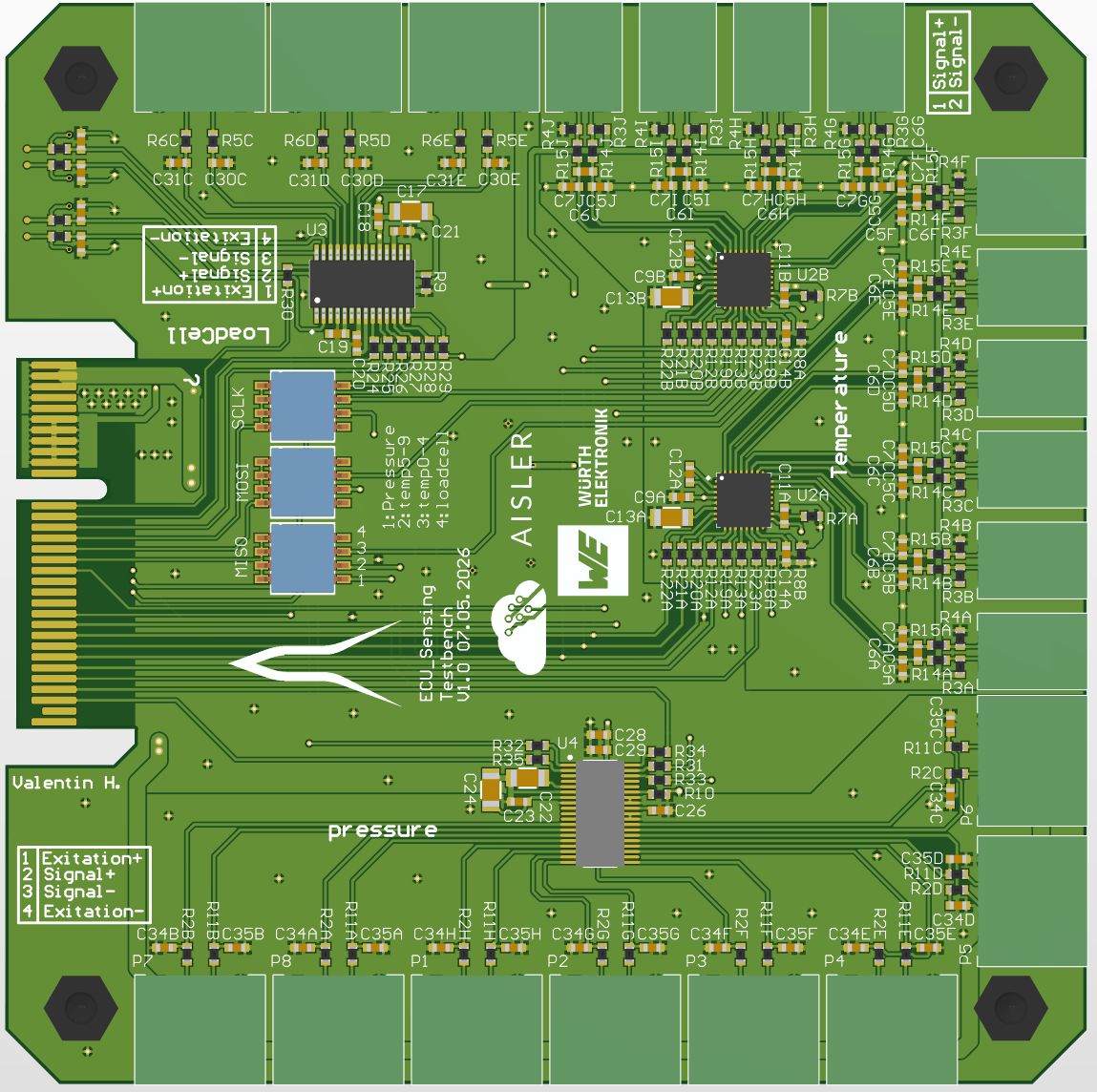
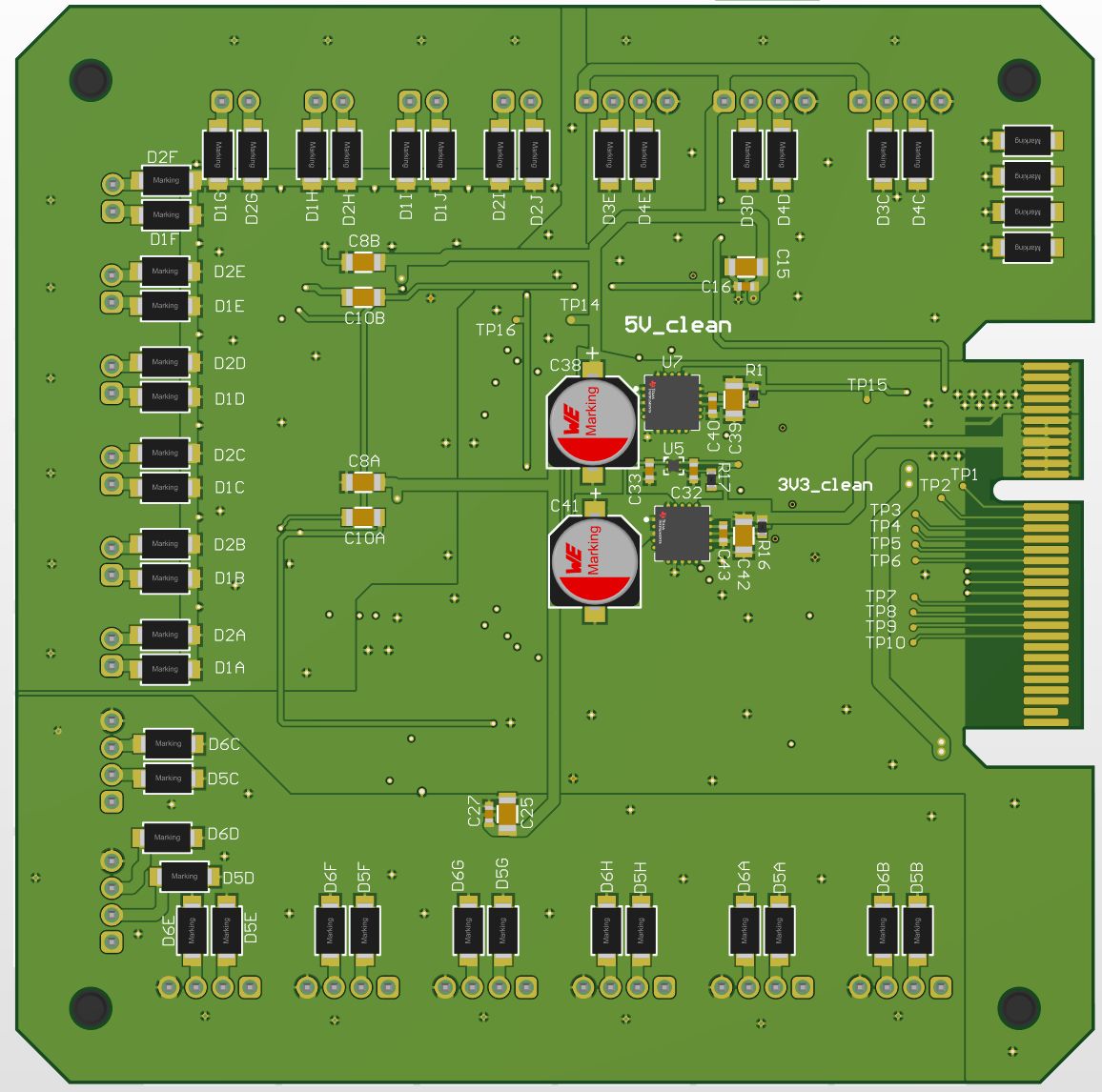
Hardware Design: The ECU_SENS Board
Overcoming Design Challenges
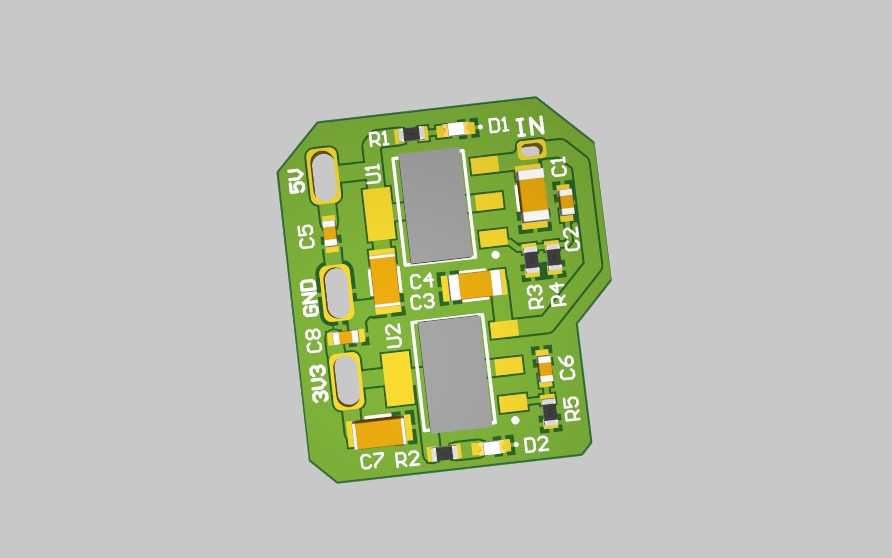
Power is routed to the board from the backplane. However, hardware development rarely goes perfectly on the first try. I made a mistake in configuring the initial power ICs, which led to incorrect power delivery. Instead of scrapping the entire board, we engineered a workaround: we designed a custom “power save” piggyback board that rides on the back of the PCB and interfaces directly with the ECU_SENS board to provide the correct voltage rails. It was a great lesson in modular debugging!
Workflow and PCB Manufacturing
Our entire hardware stack is designed using Altium Designer. We rely heavily on the Altium 365 cloud workspace, which has been invaluable for our team. It allows us to seamlessly exchange schematics, collaborate on the same project from different locations, and conduct design reviews using the built-in commenting system.
We chose Aisler for manufacturing because these key reasons:
- Seamless Integration: Uploading fabrication files directly through their Altium integration is incredibly fast.
- Team Logistics: Their platform makes team organization and the ordering process frictionless.
- Aesthetics and Quality: Simply put, the boards look amazing. Aisler’s “Beautiful Boards” service completely earns its name.
We want to extend a huge thank you to Aisler for sponsoring our project and providing excellent support along the way!