Listening underwater: AGH Marines builds a four-channel acoustic receiver
Hello everyone!
We are AGH Marines, a student team at AGH University in Kraków, Poland. We build remotely controlled and autonomous underwater robots. Our latest electronics project will help a robot find its way by listening.
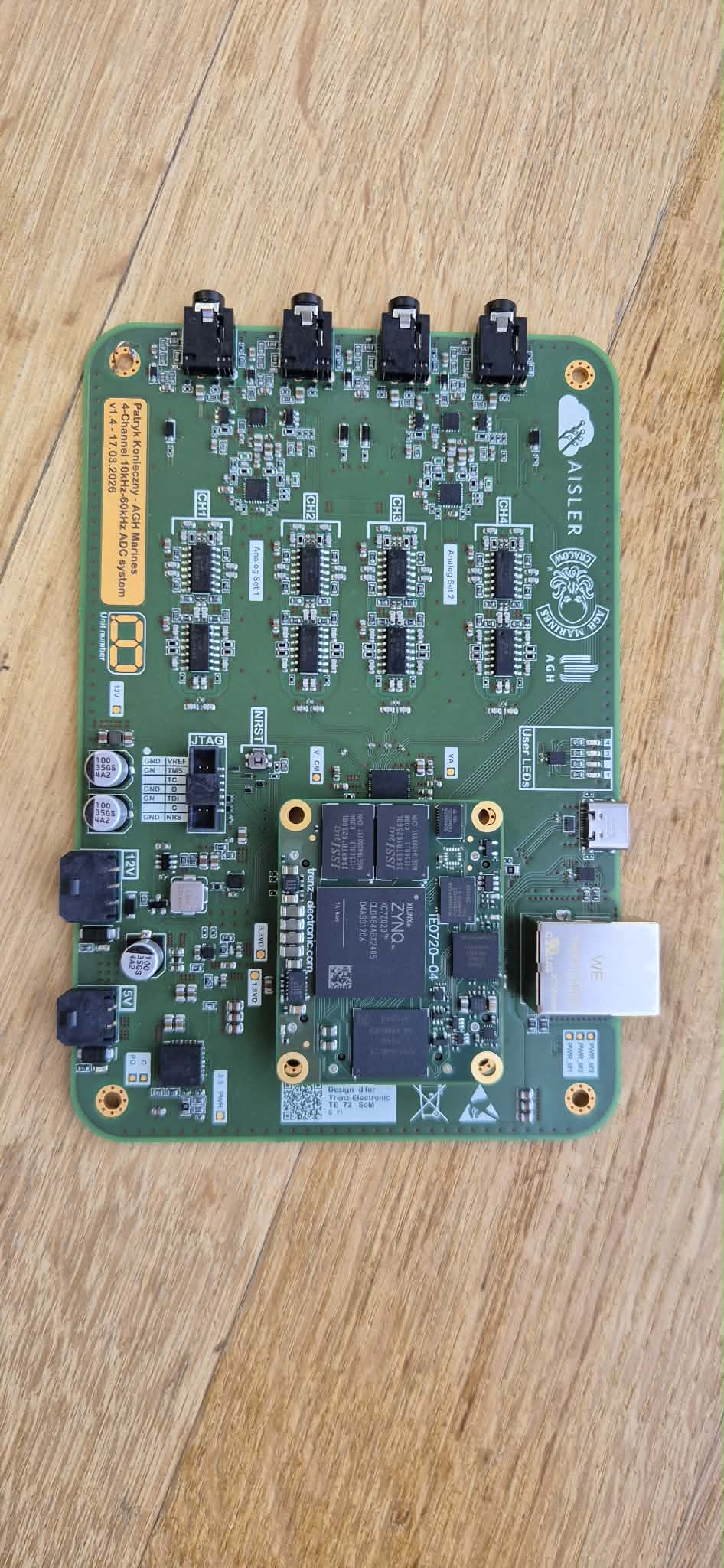
We are developing a four-channel acoustic receiver for signals from 10 kHz to 60 kHz. It combines custom analog circuits with a programmable digital system. Our goal is to detect underwater acoustic beacons and use their signals to guide our robot toward competition objectives. The hardware is assembled, and initial tests are complete. We are now developing the software and programmable logic that will turn those signals into navigation data.
From underwater sound to digital data
An acoustic pinger is a beacon that sends sound pulses. Hydrophones are microphones that detect sound underwater. Our receiver will process signals from these sensors and provide a platform for testing methods to locate a pinger.
The printed circuit board (PCB) carries a Trenz Electronic TE0720 module based on the Zynq-7020. This chip combines a processor with an FPGA, or programmable digital logic. That gives us room to develop both signal processing and control functions. Four 3.5 mm sockets provide the signal inputs. USB-C and Ethernet provide communication connections.
Preparing the signals
Each input needs amplification and filtering before conversion to digital data. We designed the analog path for a target frequency range of 10 kHz to 60 kHz.
The amplifier uses an AD5122 digital potentiometer, an electronically adjustable resistor, to control gain through an SPI serial connection. Our designed gain range is +15 dB to +40 dB. The next stage converts each signal into a differential pair. An eighth-order Sallen-Key filter then reduces unwanted frequency components before conversion. At the center of the receiver is the ADS127L14 analog-to-digital converter (ADC). This component samples all four channels simultaneously with 24-bit resolution.
Designing the board
We used Altium Designer and chose a four-layer PCB. The board needed space for analog circuits, high-speed connections, several power supplies, and fine-pitch module connectors. We routed every trace manually, with the high-speed and analog connections first. We kept component placement on one side to simplify reflow soldering.
We also made room for some personality. Curved traces and marine artwork connect the board to our team’s underwater projects.
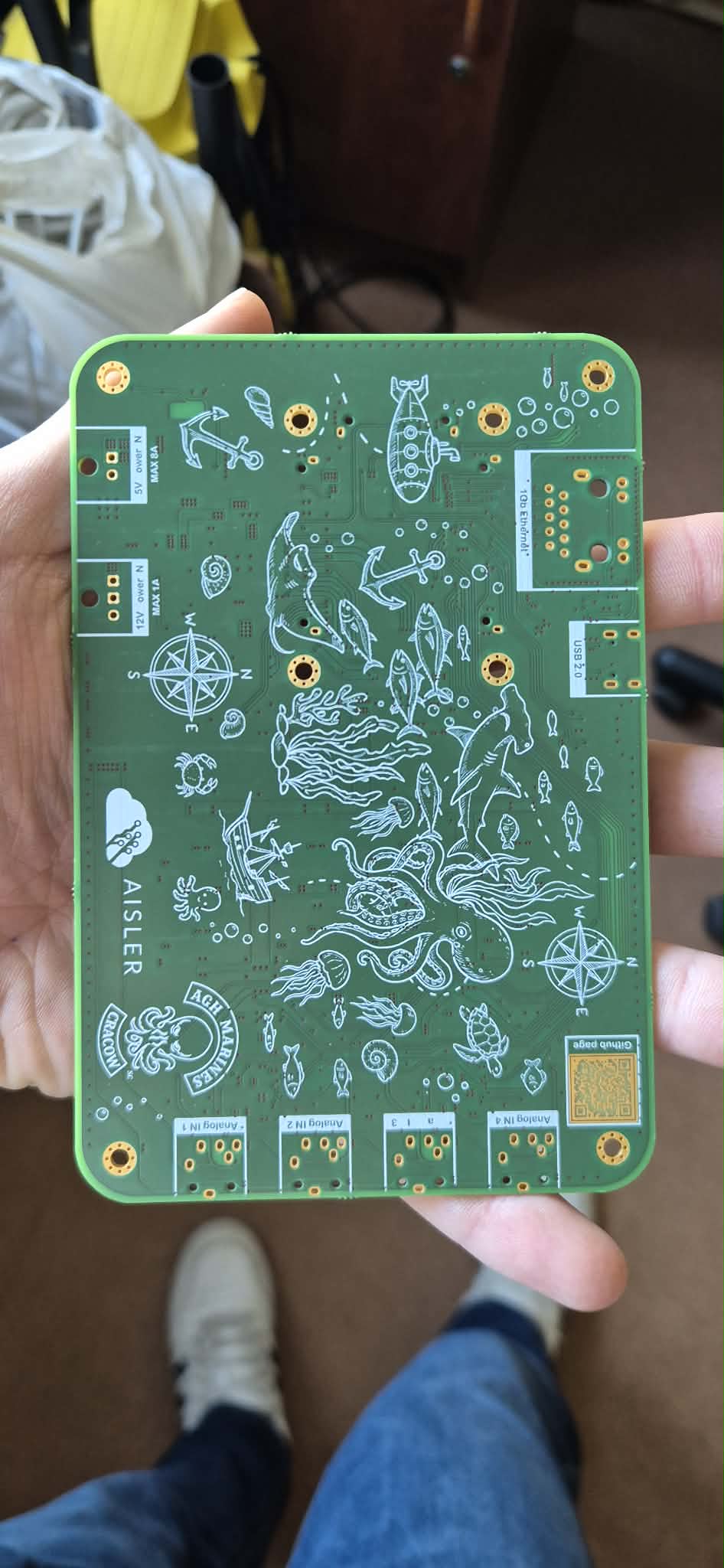
Power was another part of the design. The robot supplies 12 V and 5 V. The board also uses 5VA, 3.3VPWR, 3.3 V, and 1.8 V supplies. A TPS7A9001 regulator provides the low-noise 5VA supply for the analog circuits. A separate MPM3683GQN-7 power module supplies 3.3VPWR for the TE0720, with capacity up to 8 A. We kept this supply separate from the 3.3 V supply for nearby control circuits to reduce noise coupling.
Working with AISLER
For this design, AISLER’s detailed PCB documentation and calculated impedance values were especially useful. Impedance describes how a trace behaves with changing signals. Those values helped us plan the high-speed connections.
We also valued the inner copper thickness for power routing and heat spreading. Electrical testing for short circuits gave us another useful manufacturing check before assembly.
First signals, first success
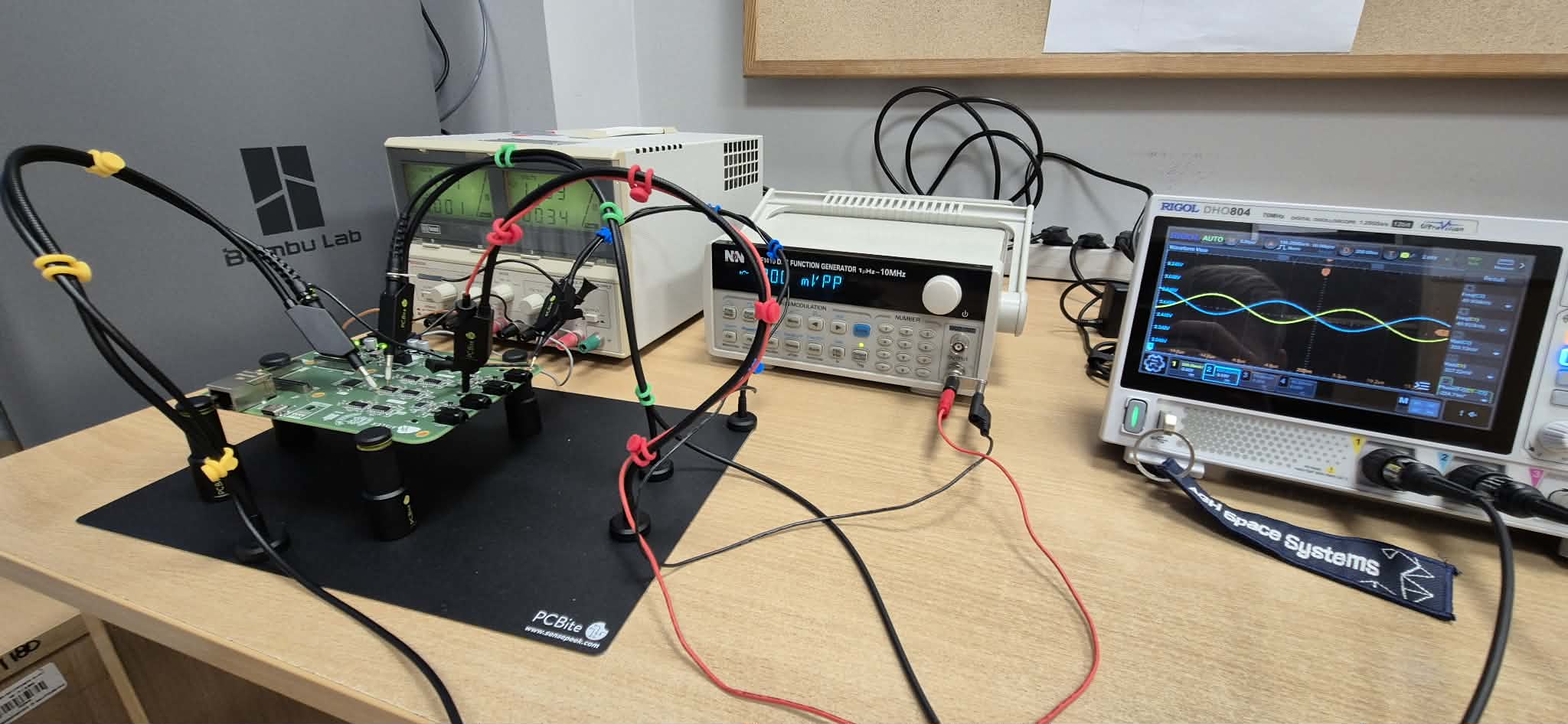
Our initial analog measurements followed the LTspice circuit simulations, with a gain difference of about 4 dB. That gave us a useful starting point for further testing.
Another highlight was seeing the correct device identifier in Vivado, our FPGA development tool, and running the first LED blink program. After the design and assembly work, that small blinking light was worth celebrating.
What comes next
We are now developing the software and FPGA logic for signal reception, analysis, and acoustic localization. The receiver is still in development, and robot navigation remains our goal.
Are you working on underwater acoustics or receivers with several synchronized channels? We would love to compare approaches as we believe we have only discovered the tip of the iceberg here.