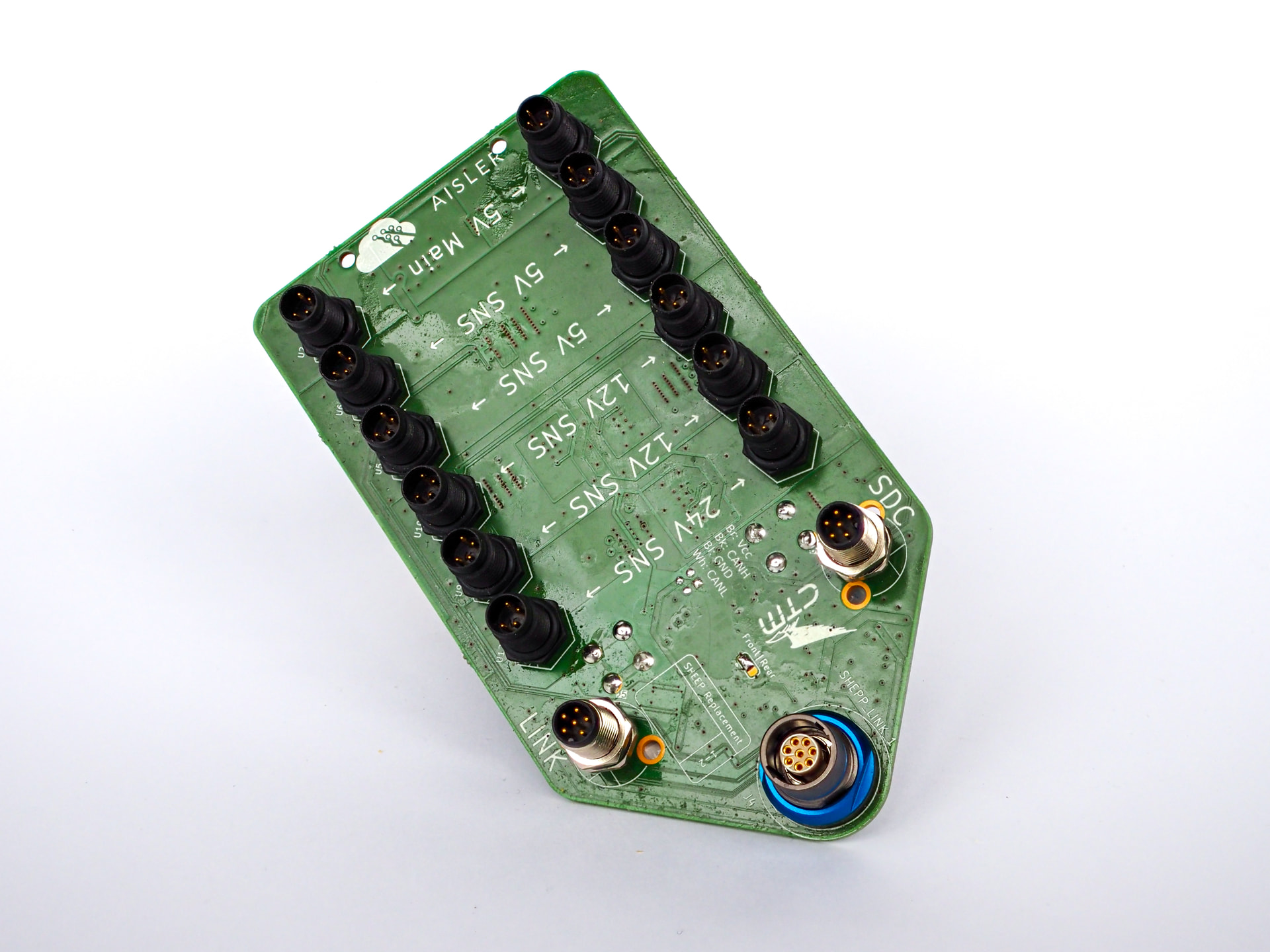
Introducing our first revision of the Smart Peripheral Power Hub
Hello fellow makers,
We are proud to introduce the first revision of our custom-built Smart Peripheral Power Hub, a platform designed to simplify the integration of sensors, actuators, and other electronic peripherals into our race car.
The Smart Peripheral Power Hub combines two essential functions in one system: intelligent power delivery and flexible CAN bus routing. Our objective was to create a standardized interface that allows peripherals to be connected quickly and reliably, without requiring a dedicated wiring and power solution for every individual device.
Each peripheral connects through a standard four-pin M8 connector. The interface provides power, ground, and a CAN connection, allowing sensors and actuators to be integrated with minimal wiring. The connected peripheral communicates its requirements to the hub, including the CAN bus it should use, the required supply voltage, and its maximum current consumption.
The Smart Peripheral Power Hub then configures the connection accordingly. This allows different types of peripherals to use the same physical interface while the hub manages their electrical and communication requirements.
At the center of the system is an STM32G474RET6 microcontroller. It controls the CAN routing, communicates with the individual power-management stages, monitors the status of the connected peripherals, and provides the software interface required for configuration and diagnostics. The controller also includes dedicated FDCAN peripherals for communication with the vehicle’s main, sensor, and auxiliary CAN networks.
The CAN routing is handled by MAX14778ETP+T analog multiplexers. Each peripheral module can select between four CAN networks: the initialization CAN, main CAN, sensor CAN, and auxiliary CAN bus. This makes it possible to assign a peripheral to the appropriate vehicle network without changing the wiring harness or adding a separate CAN interface for every application.
The CAN interface itself is designed around MCP2558FD CAN FD transceivers. This allows the system to support modern CAN FD communication while maintaining a clear separation between the vehicle’s different CAN networks. Address resistors on the peripheral modules provide individual identification, allowing multiple modules to be connected and managed within the same system.
Power delivery is handled independently for each peripheral channel. The power stage is controlled by an Infineon XDPP1148-100B digital power controller, which monitors the output voltage and current and controls the corresponding switching stage. The MOSFETs are driven by 2EDL8124G3CXTMA1 gate drivers, enabling efficient buck conversion from the vehicle’s low-voltage supply.
This architecture allows each peripheral to request the voltage and current range it requires. The Smart Peripheral Power Hub can then generate the appropriate supply while monitoring the output for abnormal conditions such as overcurrent, short circuits, or unexpected power consumption.
This is particularly useful for distributed sensors and actuators, which often require different supply voltages and have significantly different current demands. Instead of designing a dedicated supply circuit for every device, all peripherals can use the same standardized interface and rely on the power hub to provide a controlled and protected supply.
The first revision of the board provides twelve peripheral channels. This gives us enough capacity for a wide range of vehicle applications, from temperature and pressure sensors to actuator modules and other distributed electronic systems.
One of the main advantages of this approach is the separation between the peripheral and the vehicle infrastructure. A peripheral only needs to implement the standardized M8 interface and communicate its requirements. The Smart Peripheral Power Hub handles the remaining tasks, including CAN bus selection, power conversion, current monitoring, and system diagnostics.
This also makes future development considerably more flexible. When a new sensor or actuator is introduced, it can be designed around the same interface instead of requiring a new wiring concept and a dedicated power supply. The peripheral becomes a modular building block that can be integrated into different parts of the vehicle.
The Smart Peripheral Power Hub is the first step toward a more modular and intelligent electrical architecture for our race car. Future revisions will focus on improving diagnostics, increasing power density, refining the configuration protocol, and further simplifying the integration of new peripheral modules.
Our aim is to make the electrical architecture as flexible as possible: one standardized connector, configurable power delivery, and access to multiple CAN networks in a single compact system.
If you would like to learn more about our work, we are Campus Tirol Motorsport, the Formula Student team from Innsbruck. Stay tuned for more updates from our electronics development.