Introduction
We’re the UW Crows team, part of the Robotics and Automation Club (Koło Robotyki i Automatyki) at the University of Warsaw. We created our club to give members a place to actually build things and gain hands-on experience that’s hard to get otherwise. Our main project is Crower, our Mars rover, with which we’ve competed at events including the International Rover Challenge (IRC) and the Anatolian Rover Challenge. This post is about the science board we brought to IRC, and the repurposing we unexpectedly did with it.
The project
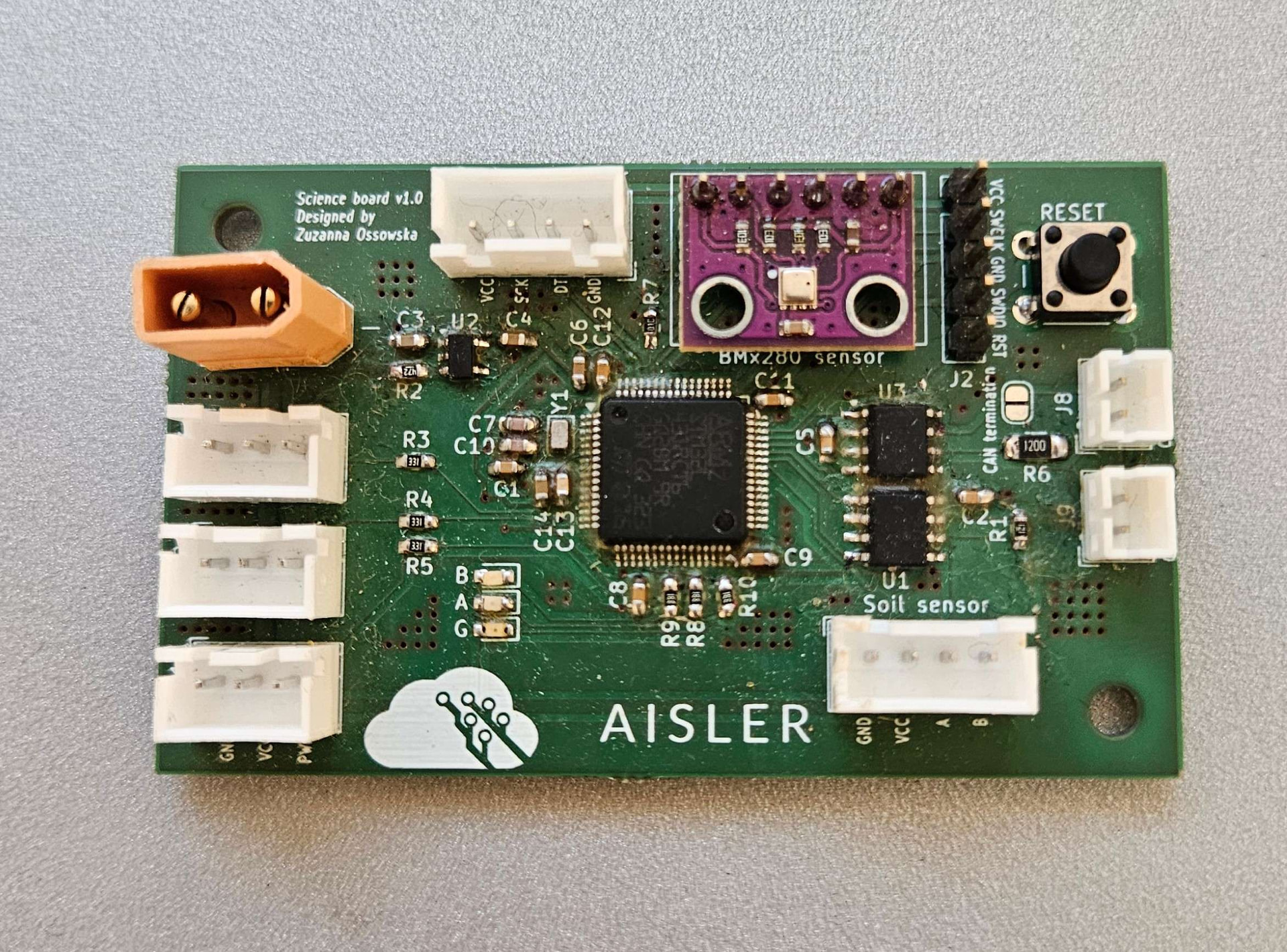
One of the tasks at the International Rover Challenge is the Astrobiology Expedition. It requires the rover to gather soil samples and measurements that help determine whether life could exist at a given site. Our idea was to combine this into one system consisting of a drill, sample storage, and sensors (soil and atmosphere). The science board was responsible for reading weight from a tensometer, controlling two servos that close and drop probes with samples, one servo to control the up-and-down movement of our soil sensor, and collecting data from that sensor as well as atmospheric temperature, humidity and pressure. It’s built around an STM32L431 microcontroller, which handles data processing and CAN bus communication back to the rest of the rover.
The board did well at the competition, gathering all the required data except for the probe-handling task, which failed due to a mechanical malfunction in our drill. It also ended up helping with something it wasn’t designed for at all, moving our onboard cameras.
Below you can see the fully assembled science board.
The repurpose
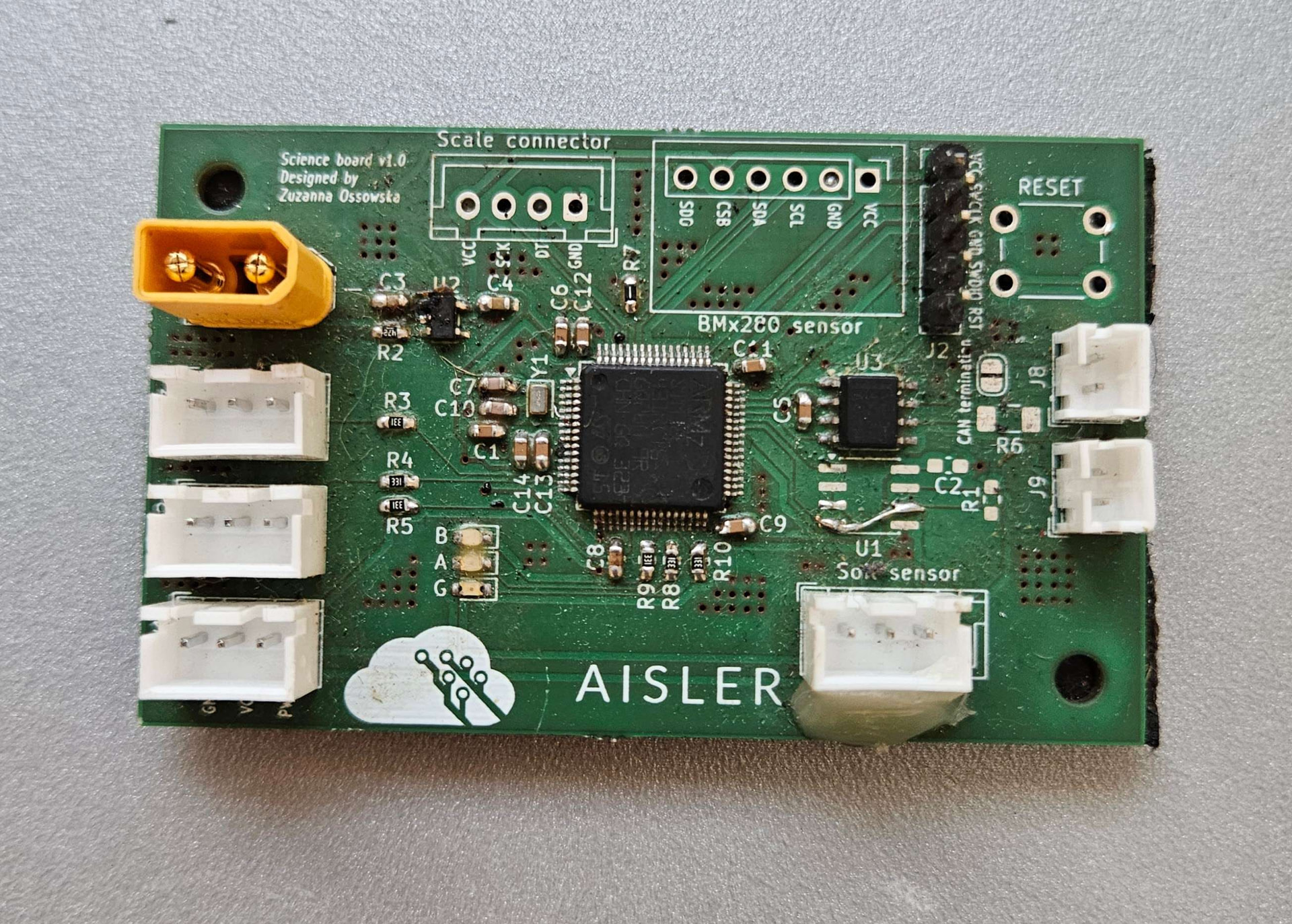
Without going into too much detail, this post isn’t really about the other board, at the competition we started seeing the boards responsible for pan/tilt of our cameras malfunction. To this day we’re not fully sure what happened. It didn’t affect every board, one or two stayed usable for a while. Our best guess is that our D-SUN step-down modules were faulty. We had our first task of the competition the next day and our cameras were still down. Needing to improvise, we realized the science board was easily convertible into a camera-movement controller. We just had to solder a different connector onto the soil sensor connection, conveniently using a pin that also carried a PWM output. The board already had tested CAN communication, tested servo control, and used an external step-down module other than the D-SUN ones. That’s how the board ended up handling a very different task than the one it was designed for.
Below you can see the version of the science board that we used to control the cameras movement.
Tips, tricks and what we learned
Bring spare boards and components to competitions, not just finished assemblies. Being able to solder replacements in our accommodation the night before saved our vision system. It also taught us that improvising and thinking outside the box can lead to pretty cool solutions.
Our favorite AISLER features
The Blitz service at AISLER is always amazing, especially when we have tight competition deadlines. It’s also really easy to preview the board before ordering, make revisions and see how the design progresses over time. We are really grateful for the partnership with AISLER that allows us to iterate, learn and ensure our electronics is reliable on all of our competitions.